Pevensey Road Ponds, Thursday April 17th, 2014

The ponds at Pevensey Road have been designed as a refuge for fish and other aquatic life in the event of any pollution incident on the River Crane in west London. They also provide additional flood storage to protect downstream homes and businesses. The ponds also recreate habitat that would have been common along our rivers, formed as a river meanders with seasonal flooding, and then being occasionally replenished during periods of high water. In the past, rivers were straightened and deepened to channel water away, but this intervention was damaging to the ecology of our rivers. As such the series of ponds provide important habitat for a range of animals and plants, which had been lost. Since the ponds were dug a couple of years ago, the vegetation has responded well, and with some sensitive planting taking place last year, are now home to a wide range of species.
Today's task, in conjunction with Richmond's TCV group, was to dig out the channel linking the ponds with the river to enable water from the river to inundate the ponds at moderately high water levels, and thus serve the purpose of a refuge. Excess tree debris was also cleared from the ponds, to prevent them from becoming silted up.
Today's photographs were taken by volunteer photographer, Paul Franklin.
Dave literally gets stuck in, and digs out the silted-up channel. 
The team works to move barrow-loads of silt.
The re-excavated channel will form a better connection with the River Crane in the distance. 
Another barrow is filled with silt.
The ponds have become a little stagnant. 
Fallen trees provide excellent habitat for mosses and fungi.
A bracket fungus. 
A fallen willow sends shoots upwards. 
Several large alder trees can be found here.
Chris clears tree debris from a pond. 
The ditch-digging is completed and the channel is reconnected with the river. 
The delicate flowers of ground ivy.
Native bluebells are abundant in the nearby woodland. 
Marsh marigolds, planted in early 2013, are now in full bloom (Photo by Chris).
Just a short distance from the busy Hanworth Road, the nature reserve at Pevensey Road is very tranquil.
The scene in March 2013 is a contrast to 13 months later, below (Photo by Chris).
April 2014 (Photo by Chris).


Marble Hill Park, Chestnut Fencing Repairs, Saturday April 12th, 2014

After about a year of promising the rangers at Marble Hill that we'd organise a group of volunteers to help repair their chestnut paling fences, we finally did so. A small, but motivated group took on the task of removing old and rotten timbers from the fences that help protect woodland habitats from park users, and particularly their dogs. This was quite a technical task, requiring straight lines and precise measurements. Under the expert guidance of English Heritage ranger John, the Trust's volunteers got stuck into the task of digging new holes, lining up the railings, cementing the posts in, and finally nailing on the chestnut palings. The finished product looks suitably rustic to blend in with the woodland, and will hopefully remain in place for many years to come. Today's photos, apart from where stated, were taken by our volunteer photographer, Paul Franklin.
This fence has clearly seen better days.
John removes a rotten fence post.
Chris digs a hole for a new post.
Precise measurements and a critical eye are essential (Photo by Chris).
Ranger John inserts a railing.
The top railing is installed.
Ramal and Caroline secure the railing to the post.
Brackets, originally dumped over a garden fence in Kingston, were recycled in Richmond.
A guide hole is drilled for nailing on chestnut palings.
The finished article, minus palings.
Newly repaired fences blending in with their surroundings (Photo by Chris).
The fate of the old pavilion, the victim of metal roofing theft, is in doubt (Photo by Chris). 
Nearby, in the meadow area, a speckled wood is spotted (Photo by Chris).
As well as cowslips (Photo by Chris).


First Elvers of 2014 Recorded at Brentford

The eel pass at Brentford was switched on earlier this week, and today (Friday April 18th) we recorded the first three elvers using it. In 2013, the first year of operation, the pass was not ready for use until May 10th, so it is hoped that this year, even more eels will be recorded passing through Brentford and reaching the end of their 2,700-mile journey from the Sargasso Sea in the western Atlantic Ocean.
If you'd like to help with the monitoring, and live locally, we're holding training sessions on April 29th and May 14th in conjunction with the Zoological Society of London. For more details, please contact chris.cockel@environmenttrust.co.uk or joe.pecorelli@zsl.org
The first elvers of 2014

Wildflower Meadow Creation, Jubilee Wood, Malden Rushett, Thursday 3rd & Saturday 5th April, 2014

Now that the season for woodland work is passed, one task that is possible is the creation and maintenance of wildflower meadows. Two sessions took place to enlarge the wildflower area created at Jubilee Wood. Most of the meadow is composed of rather rank and coarse grass, but now a small corner of the meadow is flower-rich. Volunteers from Cisco and a group of our Duke of Edinburgh students and their parents helped to double the size of the wildflower area. With any luck, by late summer, the area will be awash with flowers and butterflies.
Cisco volunteers get to work expanding the wildflower area. 
The group, looking rightly satisfied with their afternoon's work. 
A few days later, D of E students and their parents enlarge the patch still further. 
Once the hard digging has been done to remove nutrient-rich topsoil, the ground is raked and levelled ready for seed. 
Seed is mixed with a little sand to assist spreading. 
By late summer, this muddy patch may look like the area below. 
The existing meadow area photographed in summer 2013. 
Despite a recent dry spell, the wood remains water-logged and blooming with marsh marigolds.
Stichwort can be found growing alongside the main pathway.
An old balloon, perhaps an escapee from Chessington World of Adventures, litters the woodland.


The Wood, Tuesday April 1, 2014

This was our first visit to The Wood for a number of months, so it was good to see that spring 2014 has well and truly sprung. As well as removing a patch of invasive snowberry plants, laurel and young sycamores, we planted a few more hawthorn plants in the new hedge. It was also an occasion to observe some of the species that call this small park home. Nearby a woodpecker could be heard tap-tapping on a tree, while beneath our feet the aroma of ramsons (Allium ursinum) was permeating the air. Another interesting find was a patch of Aquilegia (Columbine) with its blue nodding flowers. 
No springtime report would be complete without cherry blossom. 
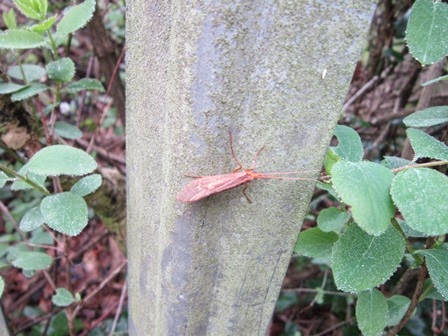
A Rhyacophilid caddisfly rests on a fence post. 
Finally, the new gate is being installed.
A curious group of cobweb spiders was spotted.
Allium ursinum plants make the most of the spring sunshine.  
Aquilegia (Columbine) nodding gently in the breeze.

Lampton Park Hedge Planting and Coppicing, Saturday March 15th, 2014

Following on from a very successful hedge planting session with ninety Year 4 children from Alexandra Primary School in Hounslow, the Environment Trust's volunteers descended on Lampton Park to do their bit. As well as planting a few more hedge saplings, we cut hazel poles and binding material from the nearby woodland to construct a section of dead hedge/hurdle. The intention is to use some of the local materials to provide some protection for the newly planted hedge.
This was a section of the park that was a little unloved, and was previously dominated by Japanese knotweed. It had been thought that the use of herbicide had successfully killed this most hardy of plants, but sadly a small node was found just starting to shoot skyward. This was dug up and left on a dry surface, hopefully to dry out.
The newly planted hedge will hopefully fill the space left by the knotweed to create a natural barrier to protect neighbouring properties from trespassers, and provide additional habitat for wildlife. We shall, of course, be back to check on the progress of the plants, and next year the aim will be to plant more hedge and make use of more coppiced materials.
Today we were joined by a local photographer, Paul Franklin, who with an artistic eye for detail helped to give the project a different perspective than usual. Except where stated, all today's photos were taken by Paul. Our young Duke of Edinburgh photographer, Ashleigh, also did an excellent job of capturing the coming of spring.
Although relatively small, the woodland at Lampton Park has a good variety of species. 
Chris explains the basics of hedge planting and care. 
Next, a course in how to build a dead hedge. 
Volunteers collect hazel poles and binders for use in the dead hedge. 
Hazel catkins are some of the first tree flowers to emerge in early spring. 
Hazel ripe for coppicing. (Photo by Ashleigh)
Volunteers get busy building the dead hedge. 
The hedge quickly takes shape.
A row of tree guards protect the newly planted living hedge. 
A horse grazes nearby. 
Although we're on the edge of an urban park not far from Heathrow Airport, you're never far from nature. 
Hawthorn leaves are beginning to appear. (Photo by Ashleigh)
Along with goat willow. (Photo by Ashleigh)
And, dogwood. (Photo by Ashleigh)
We thought the Japanese knotweed had been successfully killed. (Photo by Ashleigh)
Japanese knotweed making a final stand. (Photo by Chris)
Sadly Lampton Park isn't immune to inconsiderate homeowners dumping their rubbish in the public park. (Photo by Chris) 
Red dead nettles add a splash of colour (Photo by Chris)