Lampton Park Hedge Planting and Coppicing, Saturday March 15th, 2014

Following on from a very successful hedge planting session with ninety Year 4 children from Alexandra Primary School in Hounslow, the Environment Trust's volunteers descended on Lampton Park to do their bit. As well as planting a few more hedge saplings, we cut hazel poles and binding material from the nearby woodland to construct a section of dead hedge/hurdle. The intention is to use some of the local materials to provide some protection for the newly planted hedge.
This was a section of the park that was a little unloved, and was previously dominated by Japanese knotweed. It had been thought that the use of herbicide had successfully killed this most hardy of plants, but sadly a small node was found just starting to shoot skyward. This was dug up and left on a dry surface, hopefully to dry out.
The newly planted hedge will hopefully fill the space left by the knotweed to create a natural barrier to protect neighbouring properties from trespassers, and provide additional habitat for wildlife. We shall, of course, be back to check on the progress of the plants, and next year the aim will be to plant more hedge and make use of more coppiced materials.
Today we were joined by a local photographer, Paul Franklin, who with an artistic eye for detail helped to give the project a different perspective than usual. Except where stated, all today's photos were taken by Paul. Our young Duke of Edinburgh photographer, Ashleigh, also did an excellent job of capturing the coming of spring.
Although relatively small, the woodland at Lampton Park has a good variety of species. 
Chris explains the basics of hedge planting and care. 
Next, a course in how to build a dead hedge. 
Volunteers collect hazel poles and binders for use in the dead hedge. 
Hazel catkins are some of the first tree flowers to emerge in early spring. 
Hazel ripe for coppicing. (Photo by Ashleigh)
Volunteers get busy building the dead hedge. 
The hedge quickly takes shape.
A row of tree guards protect the newly planted living hedge. 
A horse grazes nearby. 
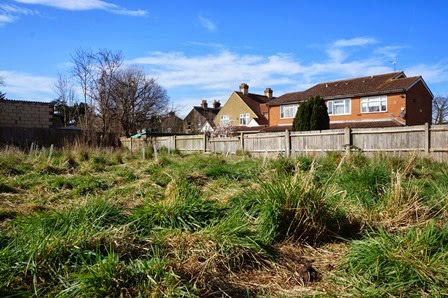
Although we're on the edge of an urban park not far from Heathrow Airport, you're never far from nature. 
Hawthorn leaves are beginning to appear. (Photo by Ashleigh)
Along with goat willow. (Photo by Ashleigh)
And, dogwood. (Photo by Ashleigh)
We thought the Japanese knotweed had been successfully killed. (Photo by Ashleigh)
Japanese knotweed making a final stand. (Photo by Chris)
Sadly Lampton Park isn't immune to inconsiderate homeowners dumping their rubbish in the public park. (Photo by Chris) 
Red dead nettles add a splash of colour (Photo by Chris)


Hedge Planting, Mill Road, Twickenham/Fullwell. Saturday March 8th, 2014

It's always good to work at a new site, and so this was our first visit to a newly opened area of Crane Park at Mill Road in Twickenham. The site was previously owned by the Environment Agency, but was recently transferred to council ownership. Along with partners, such as the Friends of the River Crane Environment and TCV, the Environment Trust was asked to help plant a new native hedge to provide additional habitat and a natural border with the neighbouring allotments.
The weir at Mill Road, Twickenham. 
The newly opened area of Crane Park. 
The old mill pond.
A new hedge of hawthorn, blackthorn, hazel, spindle, guelder rose and field maple is planted.
Boys from Tower House School prepare the ground for planting by Archdeacon School.
The recently unveiled stag beetle bench provides an excellent spot to sit and take in the peaceful scene.
A non-native American signal crayfish was found lurking in an old vacuum cleaner pulled from the murky waters of the mill pond.
The established hedge at Mill Road, planted five years ago, and recently laid by TCV and others.
Items pulled from the mill pond.
 
Some information regarding the now demolished mill at Mill Road, taken from:
 
After the Duke of Northumberland's River had been constructed in the 16th century, two mills were built on the reinforced stretch of the Crane in Twickenham. The first of these was referred to in 1753 as the New Mill: it stood where Mill Road crosses the southern stream of the Crane by the former Fulwell Park. It may possibly have been used for a while as a copper mill, but by 1767 was an oil mill. In 1799 part of the buildings had formerly been used for drying tobacco and part had been erected as a windmill. Linseed oil and cattle-cake were made at the mill in the late 18th century and the early 19th, and between 1845 and 1865 it was converted to papermaking. This also seems to have been given up fairly soon afterwards and the mill had gone out of use by 1880. 
 
From: 'Twickenham: Mills', A History of the County of Middlesex: Volume 3: Shepperton, Staines, Stanwell, Sunbury, Teddington, Heston and Isleworth, Twickenham, Cowley, Cranford, West Drayton, Greenford, Hanwell, Harefield and Harlington (1962), pp. 151. URL: http://www.british-history.ac.uk/report.aspx?compid=22290  Date accessed: 15 March 2014.
 
An image of the New Mill in 1780, probably looking upstream. It's no wonder that we found so many bricks and roofing tiles when we were planting the hedge...
At the link below, it's possible to view a much enlarged and detailed version of this picture.


Tolworth Brook Woodland Management, Tuesday March 4th, 2014

Yet again, the Environment Trust's Kingston Greenspace Volunteers returned to the small patch of woodland running alongside the Tolworth Brook. Our task today was to complete the removal of dumped rubbish behind a garden fence and to construct a dead hedge in a bid to discourage further dumping, to provide wildlife habitat, and to make use of the coppiced materials. We'll be returning to this site again to plant a native hedge. Thus far, a small area has been coppiced, opening up the woodland to increased light levels, and improving the ground flora to benefit butterflies and other species. Sycamore seedlings have also been removed to improve the ecological value of the woodland.
With all the rubbish removed, only marks on the fence show where dumped garden waste once was. The first dead hedge fence posts have been installed. 
The home owner, in the process of repairing their fence, thought it was acceptable to dump unwanted materials and garden waste into the public area. 
A one-eyed frog was just one of several curious items amongst the rubbish.
Elliot poses by the completed dead hedge. 
The trailer is again filled with rubbish, all from one inconsiderate homeowner.
As a result of repeated fly-tipping a consultation is being conducted to decide the future of the Meldone Close recycling area.
In early April 2014, we returned to plant the first new hedge plants.


St. Mary's Church, Chessington, Hedge Repair, Saturday March 1st, 2014

A rare event was witnessed on March 1st, the sun shone. So, it was appropriate that a group of enthusiastic volunteers from St. Mary's Church in Chessington turned out to help repair the hedge around the old graveyard. Hazel poles and binders had been previously harvested from the adjacent Churchfields Recreation Ground, and these were used in a traditional fashion by creating hazel hurdles to plug gaps in the hedge. Hazel is much more flexible than the sycamore we used previously, so the results were rather satisfying. As well as plugging the gaps with hurdles, hawthorn and blackthorn whips were planted, and a few select hawthorn and elm were laid to reinforce the natural fencing, and to deter hurdlers. The whips will eventually grow up and replace the fencing which will rot away after a few years.
St. Mary's Church bathed in sunlight behind a repaired section of hedge.  
The St. Mary's Team enjoy the sunshine and the satisfaction of a job well done. 
Another local resident admires the newly created hazel hurdle. 
Lesser celandine (Ranunculus ficaria) flowers open in the sunshine. 
A native five-spot ladybird also enjoys the warmth of the sun. 
An interesting and curious occupant. Sir Monier Monier-Williams, a Victorian academic, born in Bombay, died in Cannes (http://en.wikipedia.org/wiki/Monier_Monier-Williams).
Another interesting memorial to George Masters Emery, son of Michael and Maria Louisa Emery, of Lancers Cottages, Colgate, Horsham. Possibly killed at the Battle of Verdun.(http://www.britishpathe.com/video/verdun-battle-scenes/query/weapons - Warning: Unpleasant images of Verdun. A far cry from the peace and tranquillity of St. Mary's Churchyard).
Meanwhile, at the neighbouring Churchfields Recreation Ground, the trees planted in November 2012 are just awaking from dormancy, with buds of hazel beginning to appear. Even the longer course grass provides additional wildlife habitat, compared the bowling green style next to it.


Osterley Park M4 Wood, laurel clearance and tree planting, Saturday February 22nd, 2014

Today, our volunteers made a return visit to the National Trust's Osterley Park and to the M4 Wood. According to the BBC's Reel History of Britain, the Home Guard was created at Osterley Park in 1940, and was featured in a programme aired on February 26th 2014 http://www.bbc.co.uk/programmes/b014r143.
Our task was to continue removing cherry laurel trees, which if left to their own devices will negatively impact the wood as they grow vigorously in the absence of anything that feeds on them, and also they shade out native plants. The other task was to continue removing redundant tree guards, most of which have now been collected, and many reused here and elsewhere. Twenty hazel whips were also planted amongst the existing trees to improve the species and age diversity of this small patch of woodland.
The M4 Wood is coming back to life as the effects of the mild winter are felt.
Previously cut laurel is starting to rot, although it's a slow process with this species.
We'll need to check next year to ensure no cuttings have re-rooted.
Phil tackles a particularly large plant, with the noisy M4 in the background.
Unfortunately, where laurel trees have been removed, we're now finding laurel seedlings starting to germinate. At least these are easier to remove by hand weeding. Field maple seedlings were also observed, not to be confused with sycamore.
An un-germinated laurel seed.
A hawthorn tree which has swallowed up a tree guard. Tree guards left on trees too long, tend to encourage wood-loving insects such as woodlice and beetles, which in turn can result in the death of a young tree. This one seems ok, if a little deformed.
Early-flowering cow parsley. 
Red dead-nettle.
Volunteers were treated to Taiwanese Sunmerry crispy butter cakes brought all the way from the famous Yongkang Street (永康街) in Taipei. Sorry about the excessive packaging! 
We find some funny things during our projects, but this has to be one of the creepiest finds - 'If you go down in the woods today your sure of a big surprise ...'


Tolworth Brook, coppicing and rubbish removal, Tuesday February 4th, 2014

The Environment Trust's Kingston Greenspace Volunteers were back at Meldone Close along the Tolworth Brook in Berrylands to continue the job of coppicing a group of hazel trees. Some hazel was coppiced and will be used to extend the living and dead hedge started by Gerrard last year. Unfortunately, much of our time was taken up with removing rubbish dumped over a householder's back fence. Thankfully, Quadron Services provided us with a trailer in which to deposit the rubbish. Other rubbish was cleared from around the car park, which is a notorious area for fly-tipping. Hopefully, now most of the rubbish has been cleared away from the fence line, we can get on with the task of coppicing and creating a living hedge, when we're back here on March 4th. Please join us, if you can. 
Talking of Gerrard, after working with us for two years, he has finally found a full-time job working for an environmental consultancy based in the Nottingham area. We thank him for his hard work and enthusiasm while he was with the Environment Trust, and wish him best of luck 'up north!'
This also means, that there is a vacancy for a project assistant, to help organise our nature conservation volunteering activities, including working with schools and corporate volunteers. Please forward a CV and covering letter to Chris at chris.cockel@environmenttrust.co.uk.
Gerrard's hedge, still intact and looking good in the winter sun.
Rubbish dumped over a fence into the public area.
The mark on the fence is the height to which dumped grass clippings had reached. We were careful to make sure no hedgehogs were hibernating in the pile. 
A family who no longer needed seesaws, a trampoline, numerous balls, and an ornamental brick well.
 
Harlequin or native? 
Quadron's trailer was half filled with rubbish dumped over the fence of just one property.