Richmond Park, Hazel Tree Hunt, Sunday January 26th, 2014

Despite the approaching storming weather, a few hardy souls ventured into Sidmouth Wood to plant hazel trees. Unfortunately, despite finding tree guards and stakes, the trees themselves were nowhere to be seen. To cut a long story short, after an hour of phone calls, and trekking from pillar to post, it turned out the trees were simply underneath the piles of guards - doh! Eventually, we got planting, as the rain came down, again, and planted a good number of hazel trees amongst the tall oaks. This is the culmination of several years of clearing invasive rhododendron from the wood. In 7-10 years time, we'll be back to help coppice the hazel, by which time the nature of this lovely woodland will be very different and hopefully a much better place for wildlife.
Thanks, in part, to heavy vehicles, the woodland track has become a quagmire. 
Inside Sidmouth Wood, volunteers plant hazel whips amongst the tall oaks. 
A sign explains the process of rhododendron clearance and burning. 


Kingston University, Rhododendron Clearance, Saturday January 25th, 2014

Again, the Environment Trust teamed up with the Kingston University Biodiversity Group to remove invasive rhododendron from the Kingston Hill campus. For a change the weather cooperated, and a team of around 30 students and volunteers worked to clear a large area of woodland. This week we had a young volunteer photographer, Ashleigh, to record our activities. Thank you Ashleigh. Volunteering with the Environment Trust is a great way to fulfil the volunteering portion of the Duke of Edinburgh Award. As long as you're accompanied by an adult, young people under 16 are very welcome to join our activities, and to help improve your local green spaces for people and wildlife.
Volunteers from Kingston University and Marymount International School begin to cut the rhododendron (Photo by Ashleigh P.).
The group gathers for a tea break in the winter sun (Photo by Ashleigh P.).
Nothing is too daunting for these volunteers.
Along the lawn, the extent of the rhododendron growth can be seen (Photo by Ashleigh P.).
Coombehurst House, once owned by Florence Nightingale's aunt and uncle, and now home to the university's music department, is surrounded by rhododendron. 
A tangle of rhododendron is inhospitable to wildlife (Photo by Ashleigh P.). 
 
On nearby oak trees, mosses thrive.
A ladybird is seen on a silver birch tree, demonstrating how mild the weather has been. 
In no time, the rhododendron jungle is cut down to size ...  (Photo by Ashleigh P.).
... and moved towards the chipper (Photo by Ashleigh P.).
The university's Green Team bring out the serious tools (Photo by Ashleigh P.).
A local resident demonstrates 'how not to be seen' (Photo by Ashleigh P.).
Old tree guards were also removed to be reused (Photo by Ashleigh P.).
And, Coombehurst House can again be seen through the birch trees. Perhaps Florence Nightingale strolled through the woodland here.
A sign explains why the rhododendron is being removed. 
A close-up of Rhododendron ponticum (Photo by Ashleigh P.).
Even rhododendron bashers need to put their feet up occasionally.


Clitherow's Island, Saturday January 18th, 2014

 Today the Environment Trust returned to Clitherow's Island in between the River Brent and the Grand Union Canal. Our task today was to remove invasive evergreen oak, and to improve the nature trail.
Volunteers get to work opening up views along the canal. 
This will provide improved visibility for walkers and discourage rough sleepers.
The footpath is now clearly defined and 'open for business'.
In-channel work was not possible because of the high water level.
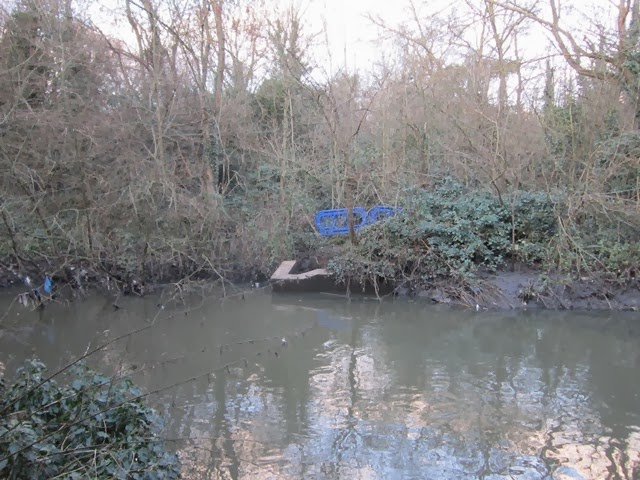
The Brent is functioning normally now that the rubbish island is history.
 Thankfully, Thames Water and the Environment Agency appear to have got to grips with the sewage pollution problem.
No longer is cloudy sewage seeping into the river from this pipe.
Jelly ear fungus (Auricularia auricula-judae) grows on dead sycamore.
Brick tuft fungus (Hypholoma sublateritium). 
Giant hogweed is beginning to appear.
Who would have thought white water canoeing was possible on the River Brent? 
Boston Manor House is nearby. 
 Along with the magnificent cedar tree planted in the 18th century.
The colours look autumnal, but it's just the light from the setting sun.
A big problem at Clitherow's Island is the presence of rough sleepers. We're working with the council to try and resolve this situation in an amicable way.
This must be more than a year's-worth of takeaway boxes, just off the nature trail.


The Wood, Surbiton, Tuesday January 7th, 2014

Fresh from our Christmas and new year break, the Kingston Greenspace Volunteers set about the task of preparing The Wood for the installation of a new pedestrian gate. The intention is to make this small woodland park more attractive to passers-by and encourage locals and visitors to explore. As well as cutting back vegetation from around the gate, a short section of hawthorn hedge was planted against the ugly metal fence that separates the publically accessible part of the reserve from the Richard Jefferies Bird Sanctuary, a few other trees, such as hazel, birch, and rowan were planted where invasive laurel and snowberry has previously been cut back.
The new pedestrian gate will go here, so vegetation was cut back in readiness. 
A native hedge will screen off the rather ugly metal fence. 
Spring is just around the corner, as bluebells start to emerge.
Nearby at Fishponds Park the London Air Ambulance pays a visit.

Crane Park Island, Hedge Management, December 14th 2013

Rounding off 2013 in the borough of Richmond, the Environment Trust's volunteers made a return visit to the London Wildlife Trust's Crane Park Island Nature Reserve. This is a nice gentle task ahead of Christmas, where volunteers trim back the hedge that borders the wheelchair accessible path, and opens up views across the reed bed. Ash, hawthorn, spindle, beech, and hornbeam were amongst the species trimmed back. 
Volunteers trim the hedge.
In other areas, the hedge has been laid.
The view across the reed bed is opened up again.
Willow sculptures add a new dimension to the woodland.
The trimmed hedge will need cutting again in 12 months time.
The view across the ruins of the gunpowder works towards the Butts Farm Estate. 
The Shot Tower is seen through the leaf-less trees on the island.


Plough Pond, Old Malden, Tuesday Decmber 3rd, 2013

The village pond at Old Malden, known as Plough Pond, is at least 500 years old, and is the one surviving pond of three that originally occupied the site. Once a rural pond alongside the village green and public house, now, surrounded by housing and traffic of southwest London. Urbanisation is not kind to sensitive habitats such as ponds, and proximity of the pond to a busy road, in the past resulted in contaminated silts entering the pond. Some years ago the pond was dredged and the connection with the road was sealed up. Previously, a pump circulated the water, but this broke a number of years ago, and would cost £15,000 to replace. This has resulted in a build-up of duck weed, which can make the pond unattractive, although a recent water quality test found the water to be very clean.
In an effort to improve the pond for wildlife and in terms of its aesthetics, the Environment Trust visited the pond to remove previously cut vegetation, remove rubbish and prune a goat willow tree that contributes excess leaf litter to the pond.
There's more to do, but a start has been made. Future improvements could include skimming some of the duck weed off the pond, and perhaps laying the perimeter hedge. Ash poles from the nearby Manor Park could be used for this purpose.
We hope to have the results of a pond invertebrate survey conducted by Linda P. in the near future. Thanks for the photos Linda.
Plough Pond looking towards the road (Photo by Linda P.)
And, looking towards the Plough pub. 
The trailer provided by Quadron Services was filled with cuttings. (Photo by Linda P.)
Those Greenspace Volunteers get everywhere. (Photo by Linda P.)
The Plough pub in 2013. 
And, in the early 20th Century.