Capital Clean-up, Elmbridge Meadows, Berrylands, Sunday April 14th, 2013

With the spring sun shining on us at last, it was the perfect day to be by the Hogsmill River in Berrylands, even if we were there to clean up someone else's rubbish. This event was part of the Lord Mayor's Capital Clean-up 2013, and our task was to remove several years'-worth of rubbish thrown over a back fence of a house in Surbiton Hill Park. With council services stretched more than ever, this was just the job for the Kingston Greenspace Volunteers. The team laboured for about four hours to clear away, three bed frames, a sofa, two bicycles, a large pile of roofing felt, a door, and 18 bags of miscellaneous rubbish, including several bags of rubbish cleared from the banks of the Hogsmill. (According to our partners at Quadron Services, we shifted a whopping 700 kg of rubbish!)
We had intended to remove invasive Himalayan balsam plants, but we had more than enough work to keep us busy, plus the recent cool weather means that the plants are still on the small side. However, we will be back soon to do battle with the balsam. There's also more work to be done to convince some residents with gardens bordering Elmbridge Meadows, that it's not acceptable to simply throw rubbish and garden waste over the back fence, particularly as the council tip at Villiers Road, Kingston is less than 2 miles away and is open seven days a week.
Despite the annoyance at clearing up someone else's mess, this was tempered by the discovery of some fascinating wildlife, including four slow worms and two frogs. Plus, the river banks were full of people and their dogs enjoying the sunshine on the warmest day of the year so far. It was also evident that the wildlife was enjoying the warm weather with chiff chaffs merrily chiff chaffing, bumble bees busily buzzing, a black two-spot ladybird beetling, and even a peacock butterfly seen flitting about. If you're still in doubt, it's official - spring has finally arrived!
 This was the task.
Here's Kingston's Capital Clean-up team. 
 Here's the afternoon shift.
This litter-lout had a taste for vodka and Polish pickle.
Our team could be described as 'Transformers'  - More than meets the eye.
The trailer full to overflowing.
There was no room in the trailer or hours left in the day to remove all the dumped rubble. 
The frogs were a hoppin'.
Slow worms were moving at their own pace. 
This one's a female.
With rubbish cleared away, lesser celandine is revealed in all its glory.
Some residents still don't get it - dumping waste is illegal

Jubilee Wood Bat Roost Repair and Wildflower Meadow Creation Tuesday April 2nd

This was our second visit to Jubilee Wood in as many weeks thanks to funding from Kingston Council. Again we were working with our local partners the Lower Mole Countryside Project to finish off the work to restore the bat roost in an World War II pill box, sow a patch of native wildflowers in the meadow, and install new benches. We also wanted to put up a tawny owl box, but due to health and safety concerns involved in climbing a ladder and the lack of a cherry picker, this will have to wait. For now, the bat roost is again ready for bats and a new area of native wildflowers has been sown to improve habitat for butterflies and other insects in the meadow. Later in the year we hope to return to Jubilee Wood to do some bat surveying and hopefully to reinstate the second pond, which is slowly being taken over by willows and other woody species. We will, of course, keep an eye on the meadow as it develops, so watch this space for all the latest news!
The team gets to work preparing the meadow for seeding.
The meadow isn't much to look at yet, so here's the team instead.
Meanwhile, another team from the Lower Mole Project works to install new benches. 
Lovely job!
Now there's somewhere to sit for lunch.
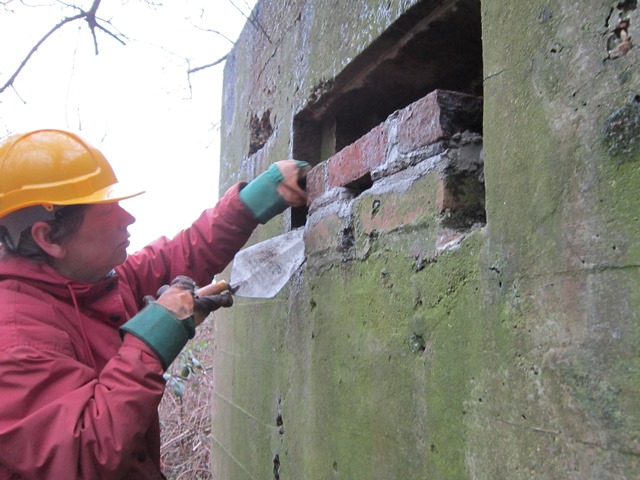
The bat roost with newly bricked up gun ports.
Gerrard, of the Kingston Greenspace Volunteers, attaches reclaimed bat roosting tiles. 
And, then seals up the remaining gun port.
Nick's excellent work on producing a new door, although a second coat of paint is needed to cover the finger prints.

Jubilee Wood, Bat Roost Repair, Sunday March 24th

The project to restore the bat roost and improve the wildflower meadow at Jubilee Wood Local Nature Reserve has been made possible thanks to local people voting for the project in the 'Your Money, You Decide' scheme. The Environment Trust has teamed up with the Lower Mole Countryside Project to improve the reserve for wildlife and local people. The award of funding from Kingston Council allowed a new metal door to be installed to prevent a repeat of the previous vandalism and anti-social activities. The roost is located inside a World War II pill-box. The gun-slits are bricked up, leaving a small entrance for common pipistrelle bats to enter. Reclaimed roofing tiles attached to the internal walls, will provide a humid and safe environment for the bats to roost. All bats are protected by law, which includes their roosts. (UK bat legislation).
A new sign was also fitted to the gate of the reserve on Fairoak Lane, as even some local people are not aware of the existence of the reserve. New benches will be located near to the ponds, a tawny owl box, made at the nearby Headley Court Defence Medical Rehabilitation Unit, will be put up in a tree, and a new interpretation board will be installed at the reserve entrance.
Other tasks include: improving the wildflower meadow by seeding, plug planting and reinstating a more traditional mowing regime to lower the fertility of the soil and improve conditions for native wildflowers. Later in the year, the reed-beds will be cut back and a second pond, now largely overgrown, will be opened up again.
Our first session at Jubilee Wood was regrettably cut short by the freezing temperature, leaving even more to complete at our next event at the reserve just after Easter on Tuesday April 2nd. Why not join us and work off that Easter egg while improving a local nature reserve.
The Jubilee Wood pill-box 
 Gun slits with remains of old bricks
Elliot cleans away old bricks in preparation for ...
...Pamela to add bricks. 
Not bad for a first try, including small gap for pipistrelle bats to enter.
Pamela cleans out the inside of the pill-box - not a pleasant job.
Meanwhile, Ted prepares the entrance for a new sign, as Connor and Reuben supervise.
The new sign in place.
The pond at Jubilee Wood Local Nature Reserve.
This is how it looked in 1996.
The meadow. 
And, in 1996.
Connor assembles the tawny owl box.
The wet woodland is home to interesting plants, such as marsh marigold. 
And, yellow flag iris.

Tree planting, Churchfields Recreation Ground, Chessington. Sunday March 17th

This was the second visit to Churchfields Recreation Ground this month by the Environment Trust's Kingston Greenspace Volunteers. Thanks to a community tree pack awarded by the Woodland Trust, our volunteers spent the day planting over 200 saplings (oak, rowan, silver birch, hawthorn, blackthorn, hazel, dog wood) to supplement existing areas of young woodland. The new areas of woodland, will also hopefully serve as a buffer to improve and safeguard more mature areas of woodland.
An invitation to join the planting was extended to Kingston's Lord Mayor Councillor Mary Heathcote OBE, who planted an English oak sapling grown from an acorn collected on the Queen's estate. Before planting the oak, the Mayor, together with her consort and husband, Dr. Roger Heathcote, chatted with volunteers and congratulated them on their dedication to improving Kingston's environment. Despite the seemingly relentless rain, the volunteers, clearly inspired by the mayor's words of encouragement, continued planting until 3pm.
A number of new volunteers joined the group, including several locals, who it is hoped will help keep an eye on the young trees. Unfortunately, experience elsewhere (Wormwood Scrubs and Tokyngton Park, Brent) shows that tree planting is not universally welcomed, with some residents preferring mown grass. Young trees in these other areas have sadly suffered from vandalism as well as theft of tree guards. While the intention is not to turn such areas into forests, hopefully our new local volunteers will convince their neighbours of the value of woodland in terms of improvements to their quality of life, and to the air we all breathe, as well as to improved property values, reduced crime, and a better environment in which to raise children, not to mention the benefits for wildlife. It is also hoped that a formal 'Friends of Churchfields' might be inspired to work together on a regular basis to bring further improvements to this valuable green space on the edge of London. 
Kingston's Lord Mayor Councillor Mary Heathcote and her consort and husband, Dr. Roger Heathcote, greet volunteers at Churchfields Recreation Ground. 
The mayor plants a Jubilee Oak. 
Kingston's mayor and her consort, chat with Patrick and Angela. 
Maeve and Lucia from Marymount International School plant yet another tree. 
D of E volunteers Reuben and Ted gaining 'brownie points'. 
Ryan and Gemma work as a team.
The young trees, hopefully protected against all 'elements'. 
A small patch of woodland was also extended to provide more wildlife habitat.
 
Update - August 2013
 
During the hot weather in July extra watering was needed to ensure the new trees survived their first summer. Some trees have inevitably died, but most have survived, although a number of tree guards have been removed, and now replaced. It is hoped that further planting will take place in November 2013, as well as the creation of additional long-grass buffer strips from March 2014.
Not much to see yet, but the trees are still alive. 
A comma butterfly rests on one of the young hazel trees planted in November 2012.
A gatekeeper butterfly...   
...and a speckled wood, show the value of Churchfields rec as butterfly habitat.


Pevensey Road Nature Reserve, Sunday March 10th 2013

Teaming up with the Friends of the River Crane (FORCE) and The Conservation Volunteers, today's Environment Trust task took place just inside Hounslow at the Pevensey Road Nature Reserve. On the banks of the River Crane, a series of new ponds have been created to provide additional habitat for plants and animals to colonise. The site is rather unloved and suffers from invasion by invasive species, such as Himalayan balsam and giant hogweed, and is badly littered with rubbish. Today's event, the first by local volunteer groups, was hopefully the start of sustained management of this important wildlife corridor linking Hounslow Heath and Crane Park. Tasks today included planting up the pond and woodland edges with native wildflowers, laying a woodchip path and picking up litter. Another issue on the site is the use of the area by young lads on dirt bikes. It's understood that the area has been used for this purpose since the 1930s. Naturally, there are differences of opinion about the issue among local residents.
 
The River Crane gently rolls through Pevensey Road Nature Reserve, Hounslow
The planting team heads off through the mud ...
... and gets planting in one of the newly created ponds alongside the River Crane. 
A wonderful wetland awaits colonisation by plants and animals, such as water voles. 
The new ponds will serve as a refuge for wildlife from pollution events in the River Crane.
But, management will be necessary to ensure the area doesn't become dominated by Himalayan balsam (seedlings emerging), and giant hogweed, which is out of control upstream.
Giant hogweed photographed upstream near Cranford Park in May 2012.