Tree planting, Churchfields Recreation Ground, Chessington. Sunday March 17th

This was the second visit to Churchfields Recreation Ground this month by the Environment Trust's Kingston Greenspace Volunteers. Thanks to a community tree pack awarded by the Woodland Trust, our volunteers spent the day planting over 200 saplings (oak, rowan, silver birch, hawthorn, blackthorn, hazel, dog wood) to supplement existing areas of young woodland. The new areas of woodland, will also hopefully serve as a buffer to improve and safeguard more mature areas of woodland.
An invitation to join the planting was extended to Kingston's Lord Mayor Councillor Mary Heathcote OBE, who planted an English oak sapling grown from an acorn collected on the Queen's estate. Before planting the oak, the Mayor, together with her consort and husband, Dr. Roger Heathcote, chatted with volunteers and congratulated them on their dedication to improving Kingston's environment. Despite the seemingly relentless rain, the volunteers, clearly inspired by the mayor's words of encouragement, continued planting until 3pm.
A number of new volunteers joined the group, including several locals, who it is hoped will help keep an eye on the young trees. Unfortunately, experience elsewhere (Wormwood Scrubs and Tokyngton Park, Brent) shows that tree planting is not universally welcomed, with some residents preferring mown grass. Young trees in these other areas have sadly suffered from vandalism as well as theft of tree guards. While the intention is not to turn such areas into forests, hopefully our new local volunteers will convince their neighbours of the value of woodland in terms of improvements to their quality of life, and to the air we all breathe, as well as to improved property values, reduced crime, and a better environment in which to raise children, not to mention the benefits for wildlife. It is also hoped that a formal 'Friends of Churchfields' might be inspired to work together on a regular basis to bring further improvements to this valuable green space on the edge of London. 
Kingston's Lord Mayor Councillor Mary Heathcote and her consort and husband, Dr. Roger Heathcote, greet volunteers at Churchfields Recreation Ground. 
The mayor plants a Jubilee Oak. 
Kingston's mayor and her consort, chat with Patrick and Angela. 
Maeve and Lucia from Marymount International School plant yet another tree. 
D of E volunteers Reuben and Ted gaining 'brownie points'. 
Ryan and Gemma work as a team.
The young trees, hopefully protected against all 'elements'. 
A small patch of woodland was also extended to provide more wildlife habitat.
 
Update - August 2013
 
During the hot weather in July extra watering was needed to ensure the new trees survived their first summer. Some trees have inevitably died, but most have survived, although a number of tree guards have been removed, and now replaced. It is hoped that further planting will take place in November 2013, as well as the creation of additional long-grass buffer strips from March 2014.
Not much to see yet, but the trees are still alive. 
A comma butterfly rests on one of the young hazel trees planted in November 2012.
A gatekeeper butterfly...   
...and a speckled wood, show the value of Churchfields rec as butterfly habitat.


Pevensey Road Nature Reserve, Sunday March 10th 2013

Teaming up with the Friends of the River Crane (FORCE) and The Conservation Volunteers, today's Environment Trust task took place just inside Hounslow at the Pevensey Road Nature Reserve. On the banks of the River Crane, a series of new ponds have been created to provide additional habitat for plants and animals to colonise. The site is rather unloved and suffers from invasion by invasive species, such as Himalayan balsam and giant hogweed, and is badly littered with rubbish. Today's event, the first by local volunteer groups, was hopefully the start of sustained management of this important wildlife corridor linking Hounslow Heath and Crane Park. Tasks today included planting up the pond and woodland edges with native wildflowers, laying a woodchip path and picking up litter. Another issue on the site is the use of the area by young lads on dirt bikes. It's understood that the area has been used for this purpose since the 1930s. Naturally, there are differences of opinion about the issue among local residents.
 
The River Crane gently rolls through Pevensey Road Nature Reserve, Hounslow
The planting team heads off through the mud ...
... and gets planting in one of the newly created ponds alongside the River Crane. 
A wonderful wetland awaits colonisation by plants and animals, such as water voles. 
The new ponds will serve as a refuge for wildlife from pollution events in the River Crane.
But, management will be necessary to ensure the area doesn't become dominated by Himalayan balsam (seedlings emerging), and giant hogweed, which is out of control upstream.
Giant hogweed photographed upstream near Cranford Park in May 2012.


Hazel coppicing, Churchfields Recreation Ground, Chessington. Tuesday March 5th, 2013

Supposedly, this was the warmest day of the year so far, and it certainly felt like it. Today, as part of Climate Week, the Environment Trust's Kingston Greenspace Volunteers were working at Churchfields Recreation Ground for the first time.
There are some attractive patches of young woodland scattered around the rec., with a few well-developed stands of hazel that are about ready for a spot of coppicing. Coppicing is a traditional method of sustainably managing woodlands to provide wood products, that also has benefits for wildlife in terms of creating a greater diversity of habitats to support a greater diversity of species. Coppicing may seem rather brutal, as it involves cutting trees almost to the ground, but done in rotation on a 7-10 year cycle it can provide a range of woodland products. It also allows light to penetrate the tree canopy which in turn encourages a greater diversity of ground flora to thrive, and will also prolong the life of hazel trees, which quickly regenerate from the cut stems.
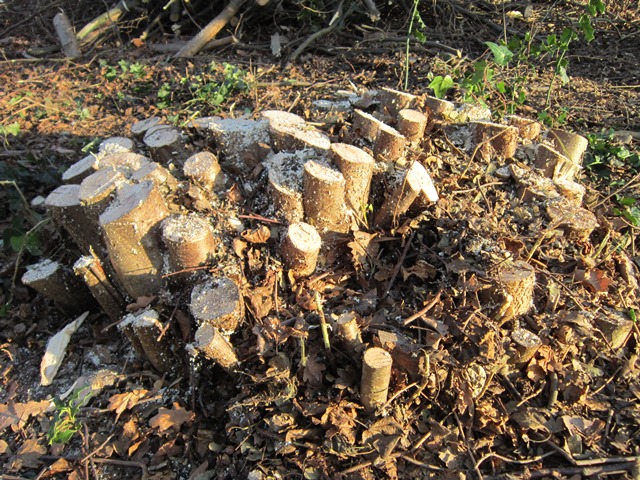
Once we started to coppice the hazel, it became clear that the current growth is about ten years old, meaning that our timing was perfect. In preparation for a community tree planting event at the other end of the rec. on Sunday March 17th (10-3), at which Kingston's mayor (The Worshipful the Mayor of the Royal Borough of Kingston upon Thames, Councillor Mary Heathcote OBE) is due to be in attendance, we decided to harvest some of the hazel for use as supports for the new trees. After a day's coppicing, although we had only coppiced a couple of the larger hazel trees, we produced over 100 tree supports, and a variety of other wood products, such as bean poles out of the long straight pieces, and firewood from some of the larger pieces. This is the last coppicing event this year, as bird nesting will begin soon, but there is plenty left for next autumn/winter.
Once the larger of the two hazels had been coppiced, it was remarkable to watch as hundreds of tiny spiders frantically began weaving their webs across the freshly cut tree stumps. A myriad of other insects also emerged into the sunlight, including a native cream-streaked ladybird and a green shield bug.
Another bonus for the day, was the group being interviewed by Kingston Green Radio as part of Kingston's Paint the Town Green festival.
Philip and Gerrard shoot the breeze at a sun-drenched Churchfields Rec. 
The hazel after coppicing.
A cream-streaked ladybird emerges from the leaf-litter. 
And, spiders take advantage of newly-created habitat.
Although not strictly a native species, a beautiful crocus makes the most of the sunny weather.
Ditto with snowdrops, although they certainly brightened a chilly and damp site visit to the rec a few weeks ago.
 

Willow Spiling, Kew, Saturday 2nd March, 2013

Back by popular demand, willow spiling is a traditional method of protecting river banks from erosion. The aim here, is to reduce the impact of the tide and wake from passing boats on the river bank, which threaten to wash away the well-used and popular tow path. The project has been running for several years now, so the live willow posts are now quite well established, although the weaving needs to be replenished and any dead post need to be replaced every year.
There's no better place to be than by the mighty Thames on a mild March morning, and even the sun made an appearance. Thanks everyone for a great morning's work - as ever.
The spiling before cutting, showing the stabilising effect and vegetation establishment.
The lads from Tower House School begin harvesting the willow. 
Tamara and Susan bundle up willow for weaving. 
The team spreads out to work on different sections. 
Newly weaved willow will hold back the waves for another year. 
The view downstream, with the Kew Bridge Steam Museum tower in the far distance. 
Thames wildwood (Martin P.)
Bowsaw art (Martin P.)
Common dog-violet (Viola riviniana) coming into flower right on cue at Kew.
Martin P. took this interesting panorama of the site looking up and downstream.


Rhododendron removal, Kingston University, February 23rd, 2013

Continuing the campaign to rid Kingston University's Kingston Hill campus of invasive rhododendron and cherry laurel, the Environment Trust again teamed up with the university's Biodiversity Group.  Where the group has worked previously, hazel has been planted and even a patch of bluebells is beginning to appear. (Photos kindly provided by Rachel).
Surely the winner of the funniest find award.
Another area now clear of rhododendron.

Ham Common Wood, Snowberry removal (Take 3), February 23, 2013

This was the third occasion that the Environment Trust's Richmond volunteers had visited Ham Common Wood to work on removing invasive snowberry plants, and this time I think we've cracked it. The only realistic method for getting rid of this North American plant that is a common invader of our woodlands, is to dig it out by the roots using mattocks and a good deal of sweat. So it was, that seven of our number took on this task. In January 2012 we cut the plants back, but they grew back. Then in January 2013, two of us tried (ironically in the snow), to dig the plants out with forks, but these really are tough customers. As such, this time we came properly armed, and in the space of three hours managed to dig out almost the entire patch. There are bound to be a few survivors to lure us back next year, but hopefully now native species can be allowed to recolonise this patch. Already, bluebells that were starting to be swamped by snowberry plants, are beginning to emerge. This year will be interesting at the pond by Richmond Park's Ham Gate, as the pond has been cleared of over-shading sycamore trees and de-silted.
And, the toad fence has appeared again around Ham Common to prevent migrating toads being squashed by cars as they cross the road look for mates in the spring. http://www.richmondandtwickenhamtimes.co.uk/news/8904441.Toads_crossing_forces_road_closures/
Don't drive, but get on your bike this year to help the toads!
Before pruning, January 2012.
After a morning of back-breaking mattocking, February 2013.
Feb. 2013, bluebells emerging where before there was snowberry.


Manor Park, footpath creation, Tuesday February 5th

Manor Park in New Malden is a Green Flag-winning park on the southern border of the borough of Kingston, not far from Worcester Park. To ensure the park retains this award, one of the key tasks was to pick up all the litter we could find. Luckily today we were joined by two officers of the law, who were happy to do their bit to improve the appearance of the park.
Our other task was to open up a new footpath through the woodland to allow local residents to enjoy the tranquillity of this young wood. Thinning of ash trees turned the woodland from a dark, rather forbidding place, littered with bottles and cans, into a light well-managed woodland.
The old wire fence, which had collapsed and was no longer serving a useful function, was removed and a new path created to lead walkers into the wood.
We also planted bluebell and native daffodil bulbs, wood anemone and lesser celandine, which hopefully will make an appearance in the spring. There was insufficient manpower to cut back vegetation from the pond, although rubbish was removed. Pond work will have to wait until the late summer.
The old fence had collapsed. 
PCSOs doing their bit. 
Elliot begins to open up the new path. 
Kingston Greenspace Volunteers have a few new recruits. 
Without the fence a natural path emerges. 
Now open to the public. 
And, another trailer-load of 'stuff', including a Tesco trolley.

Tolworth Brook, Coppicing, Sunday February 3rd

Each time our group of volunteers returns to work alongside the Tolworth Brook in Berrylands we're reminded that this area used to be home to the famous, and much missed Surbiton Lagoon, an outdoor swimming pool that opened in 1934, but closed in 1979, apparently for repairs (old excuse), and never reopened. The footprint of the old Lagoon complex is still visible in a Google Earth image from June 2003, highlighted in the photo below. Today, the area is partly a wonderful green open space alongside the brook, and partly housing, in the form of Meldone Close, which was built where tennis courts used to be.
The task for the Kingston Greenspace Volunteers today was to continue the hazel coppicing that was started at the end of 2012. Coppicing is a traditional form of woodland management, which involves cutting (mainly) hazel trees to ground level to allow more light to reach the woodland floor and thus promote the growth of an array of wildflowers. As bird-nesting season is not far off, this will be the last such event at this site until next winter. There's also quite a lot of sycamore saplings invading the area from nearby mature trees, so these were also cut back to prevent the woodland being totally taken over by sycamores, which are not as valuable for wildlife as trees such as oak, ash, hazel etc. Coppicing is normally carried out on a 7-10 year rotation, with the products of poles and bindings, being used for crafting hazel hurdles as stock fencing. The next coppicing session at this site will hopefully take place towards the end of 2013, when we'll tackle another hazel patch.
Thankfully, the forecast rain did not materialise and the group, including some new recruits, managed to create a small glade in amongst the trees. The area should quickly recover from any trampling and by April the woodland should be awash with bluebells.
Not surprisingly, we also carried away a lot of rubbish, most of which was children's garden toys, which had apparently been inconsiderately thrown over someone's back fence. Thanks to Quadron Services for providing the trailer to remove this waste which the offender should have taken to the tip or charity shop themselves.
The site of the former Surbiton Lagoon, close to the coppiced woodland.
Elliot, one of our Kingston regulars, takes a break, showing it's not all hard work.
Project assistant, Gerrard, sharpens poles suitable for fencing.
The end result, a small clearing to create a better diversity of habitats.
Here's one we prepared earlier (Dec. 2012), already starting to sprout new shoots.
Surbiton, PLEASE take your unwanted items to the local tip or charity shop, don't throw them over the fence for someone else to clear up. This is a public area, not an unloved wasteland!
That includes garden waste. An old favourite, red Cordyline australis, discarded over a garden fence. Be Plantwise
Another old favourite that's seen better days ...
... and books a one-way ticket to the local tip.
Talking of favourites, a wheelie bin retrieved from the Tolworth Brook.