Big Balsam Bash on the River Crane, Sunday May 13th

As part of London's Capital Clean-up sponsored by Proctor & Gamble, the Environment Trust teamed up with the Friends of the River Crane Environment and The Conservation Volunteers (formerly BTCV), to try and reduce the abundance of the invasive plant Himalayan balsam from along the River Crane. Left to its own devices, Himalayan balsam outcompetes and overshadows native plants, and deprives them of pollinators. While it is unlikely that Himalayan balsam can be eradicated, its prevalence can be reduced by hand weeding. Groups around the country, including the Quaggy Waterways Action Group (QWAG) in SE London have had success in controlling Himlayan balsam, and new initiatives are taking off such as on the River Test in Dorset and Hampshire http://www.hwt.org.uk/news.php/665/test-news Thankfully, Himalayan balsam seeds only remain viable for about 18 months, and viable seeds will normally germinate in the first season. This means that it should, in theory, be possible to elimiate this plant from a catchment, given sufficient volunteer effort. However, it only requires one plant to release its 800 seeds (30,000 seeds per square metre in dense stands), to undo all the good volunteer work.

If you missed out on the Big Balsam Bash, there's still a chance to do your bit. Our monthly event on May 26th (10.00-1.00) will be our very own balsam bash by the River Thames at Ham. Meet at the Ham House car park. It'll be muddy, so wellies are recommended.

Balsam bashers get stuck in amongst the stinging nettles.

The balsam has been slow to get going this year, but it'll soon tower above the nettles.

Himalayan balsam - Impatiens glandulifera (left) seen growing alongside orange balsam - Impatiens capensis, a smaller species native to North America, but seemingly increasingly common on British river banks.

Hedge Management Old Deer Park Saturday April 14th

A short stretch of hawthorn hedge was planted by the Trust and Tower House School in February 2006 and has now filled out quite nicely. The aim of this month's task was to trim the hedge to allow it to become more bushy so it provides better habitat for birds and other wildlife. Plus, it looks so much better than a bare mown bank. Robinia pseudoacacia suckers that have appeared were also cut back as they were over-shadowing the hedge and literally sucking all the water out of the ground. Robinia, which is native to north  America, is a seriously invasive tree in central Europe (see the Cabi Invasive Species Compendium).
April is a little late for this type of task due to the bird nesting season. Luckily, the only bird we came across was a curious robin. 
This is the hedge in April 2012 
Contrast with the day it was planted by the boys from Tower House School in February 2006

Nick, James and Thomas put their backs into rebuilding the protective fence

The hedge after its short back and sides 
Robinia suckers needed to be cut back 
Robinia seed pods ...
... and thorns 
What team work! 
Cherry blossom at its best 
Cuckooflower (Cardamine pratensis)
Plus orange tip butterfly
An unlikely place to find asparagus

P.S. Apologies for any confusion over the date of April's event, but Chris took part in the London Marathon on April 22nd in aid of the Stroke Association (http://www.justgiving.com/Chris-Cockel) (Update: completed in 4:04:58 - thanks for all your support).

The next monthly event will be on Saturday May 26th (see the diary to the right for further details).

Kilmorey Mausoleum and Richmond Pocket Parks March 24th, 2012

While the current drought conditions in the Southeast of England are bad news for people and wildlife (so please save water), the gorgeous weather meant that the Environment Trust was able to offer a bumper volunteering day. Three groups were deployed to smarten up the borough, at Kilmorey Mausoleum and the ever popular Richmond riverside.

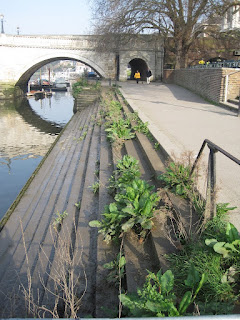
Tidal flooding has resulted in a build up of sediment on the riverside path, which has been colonised by vegetation.
Volunteers from the Columbia University Club of London get to work and reveal the buried path.
After a final sweep, several feet of path is again available to 'promenaders'.
The steps were also being overtaken by vegetation.
With the tide quickly rising, Columbia volunteers remove the last few plants ...
... producing a much cleaner appearance.
Meanwhile, the girls from Marymount School give Bridge House Gardens a spring clean.
A short distance away, the boys from Tower House School took on the task of re-laying a woodchip path at Kilmorey Mausoleum.
Visit the Kilmorey website for details of open days in 2012 http://www.kilmoreymausoleum.co.uk/Kilmorey/Kilmorey-Mausoleum-home.html
With a small mountain to move, the boys waste no time in filling barrows and buckets.
In no time at all the wood chip pile becomes a path, which is also beneficial to stag beetles.
 
The finished result looks ready for visitors.
There's even a pond.
The garden at Kilmorey is just coming back to life. Come and visit on one of the summer open days to see it in all its glory.
 
The Tower House boys get a rare glimpse inside the mausoleum.
And finally, the famous Kilmorey compost toilet is occupied.

Ham Common Litter Clearance - Saturday March 3rd


Members of the Ham and Petersham Association gather for litter picking on Ham Common.
(Notice something not quite right with this photo? Tell us via Twitter @EnvTrustVols or comment here)

This week the Environment Trust teamed up with the Ham and Petersham Association (HPA) to help clear litter on Ham Common. Despite the threat of rain, a group of willing volunteers clutching rubbish bags and litter pickers fanned out across the common and into the woods, emerging some time later with bulging bags of rubbish, which Richmond Council took away.

The invasive snowberry near the pond at Ham Gate was also tackled again, with all above-ground stems cut and more of the roots dug out. With the bluebells beginning to appear, it is easy to appreciate why it's important to remove the snowberry. Where the snowberry has become established, there are no bluebells. This site will need to be revisited to ensure complete removal of the snowberry in the coming years. 

The Ecology of Fallow Deer - Richmond Park February 26th

What a wonderful way to spend a sunny February Sunday, walking around Richmond Park learning about the ecology of the fallow deer.
John Lock, an Environment Trust volunteer and local deer expert, led a priviledged group on this fascinating walk. It didn't take long to get away from the crowds, to areas of the park where the ritual that is deer mating is played out each year. John put the group in the mind set of a male deer as it sizes up his rivals and competes for females. The group were shown, and were able to handle, a selection of fallow deer antlers from animals of all ages, to understand their importance in deciding the pecking order for male deer. Over the course of the walk, the group saw almost all the park's fallow deer and also some rather intimidating-looking red deer, the fallow deers' larger cousin.

John Lock explains about fallow deer antlers.

Richmond Park looking a bit like African savanna, complete with a herd of fallow deer.

Meet the cousins, aka the red deer.

White Lodge, Richmond Park.

Willow Spiling Saturday February 25th

With the perfect sunny weather for a spot of willow spiling, the Environment Trust's volunteers were eager to return to a project that has been developed over several years. The goal is to create a living willow defence against the action of the tide and wash created by larger boats on the river. This particular section of river bank is semi-natural, not being reinforced with concrete, as is the majority of the tidal Thames, but this also means that it is especially vulnerable to erosion. While natural river function is generally to be encouraged, the popular stretch of path between Kew Bridge and Richmond is a wonderful resource for local people and visitors alike, so the willow spiling will help to prevent it being washed away. Over time, sediment will accumulate behind the spiling, which hopefully will become vegetated, so creating a natural defensive barrier. Much better for wildlife than ugly concrete.

As always, the boys from Tower House School were on hand to prepare the willow and sycamore whips for weaving into the spiling. Another team of volunteers worked on tying the willow faggots together, while a third group had the tricky job of weaving the faggots between the living willow stakes. Despite the mud and the long walk to the site, everyone went away with a smile on their face, having completed another worthwhile task for the people and wildlife of southwest London. Two big bags of rubbish were also collected and carried the long distance back to the car park at Kew. This month, an old Batey Ginger Beer bottle, perhaps from the 1950s, was added to the vintage bottle collection.

The boys get to work preparing sycamore whips.
Nick showing the others how it should be done.
This is the tricky weaving bit.
What a lovely day to be beside the Thames.
The finished article. Come back and see it come to life in the spring.
Plus, the winter aconite bulbs we planted by the Kew railway bridge are in flower.
Spiling with the aid of a digger.

Ham Common Habitat Management, Including Removal of Invasive Snowberry Saturday January 21st

 
Before
After
With the continued mild weather we again had a good turnout for our Ham Common event, including the reliable and enthusiastic boys from Tower House School.

Ham Common was grazed until the 19th Century, since when it has reverted to mixed woodland of oak, ash, silver birch etc.

Our task was to clear scrub, including invasive snowberry, from around a small pond to encourage the growth of wetland plants in the pond, and ground flora on the banks, and to improve public access to the area.

The Tower House boys didn't need much encouragement to get to work with loppers clearing away brambles from around the pond, while another group of volunteers took on the snowberry (see the separate page for more details about this species http://www.etrutvolunteering.blogspot.com/p/snowberry-symphoricarpos-albus.html). With little information about how to effectively manually remove snowberry, we took a two pronged approach of digging and pruning. Being such a deep-rooted plant, it is inevitable that there will be enough re-growth for the group to make a return visit.

Clear from self-seeded sycamore saplings and brambles, the pond is much more open and light and now provides a lovely area away from the hustle and bustle of Richmond Park. 
 
New volunteers are always welcome to join us, usually on the last Saturday of the month. Recently, we've been joined by two young volunteers (and their parents) working towards their Duke of Edinburgh Award. Volunteering with the Environment Trust is a great way to fulfill the volunteering requirement of the D of E, so please get in touch with chris.cockel@environmenttrust.co.uk and see this link for more information about the volunteering part of the award http://www.dofe.org/en/content/cms/doing-your-dofe/activities-sections/volunteering/

   
No flint hand axes this time, only a 19th Century apothecary's bottle, which almost found its way into the recycling.